A challenge I haven’t been able to fully resolve is dispersion. There are so many things to do, and so many ways our attention can be extracted. Knowing you want to do something while you’re stuck doing something else is exhausting. Naturally, the best thing to do is give yourself more free time to pursue the interests you didn’t have time to do before.
I’ve spent nearly three years living life almost entirely on my own terms. But I now I realise that my original plan was short-sighted. There are problems that freedom alone does not solve, ones that barely even register until they challenge everything you know about yourself.
I want to talk about dispersion, and how to overcome the challenge of spreading yourself too thin. And if you’ll indulge me, I’ll share a story about how the life of freedom I’ve built for myself brought a completely different problem home to roost.
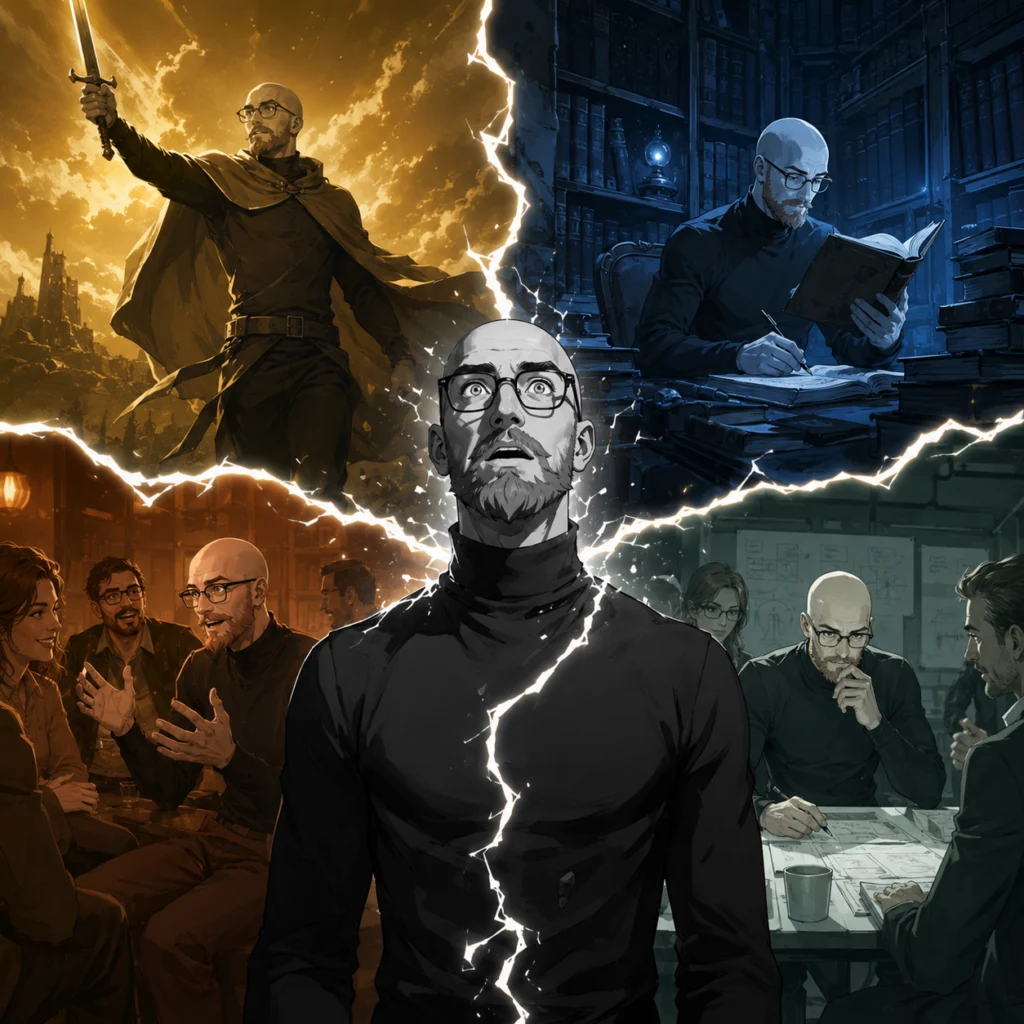
Dispersion
Dispersion means taking something and spreading it out over a wide area. As an example, light is dispersed into different colours when it refracts through glass or water. We become dispersed when our attention is refracted across a number of different areas of life. This could be our job, school, family responsibilities, home life, hobbies, and any number of other things. The more things to focus on, the more fragmented we become.
Even your finances can become dispersed. Diversification is generally useful as it spreads risk out across a number of investments. That being said, this is only useful if the portfolio is structured around achieving a particular goal. Not only does this dispersion become confusing and costly to manage, it also takes a mental load that pulls you away from everything else in your life. Spending this mental capital managing burdens is inefficient and dangerous.
We only have so much time and attention each day. Ideally, we spend it on things that matter. It’s impossible to make meaningful progress towards our goals if our attention is dispersed across too many responsibilities. Worse still, it renders us unable to maintain the systems that keep us where we are. The solution, therefore, is to limit how much we are dispersed, or limit what we focus on at any given time.
Over the last two years, I’ve created a simple life that allowed me to focus on my health and my writing. I now realise this came with a number of challenges I wasn’t prepared for.
Freedom Leads to Dispersion
I remember finishing the last day of my consulting job and feeling completely unburdened. For the first time in my life, I was completely free. And I loved that feeling. When you’re free, you can do whatever you want, whenever you want. And unless you do something drastic, there aren’t really any consequences. But freedom comes with its own costs; costs that you don’t realise you’ve paid until much later.
When we are free to do anything, we divide ourselves up among a variety of different interests. This creates a growing number of open loops. But of course, it sounds perfectly reasonable to explore whatever takes our fancy. Why wouldn’t we do this? Isn’t it a good thing to be able to explore and experiment? As it turns out, it’s both good and bad. It allows you to learn more about yourself and how you want to spend your time. But that freedom becomes a form of entropy that disperses your focus across a growing number of open loops.
One major benefit of my transition away from permanent full-time employment has been the freedom to re-explore writing. It’s an interest I’ve had all my life, but one I neglected during my career. On top of personal finance, I’ve also researched history, literature, philosophy, and esotericism. I even maintained the interests and friendships I’ve built over the last few years (getting much better at the latter). But with all of these interests pulling me in different directions, I found I was losing the strength to pull on any of them in turn.
Dispersion and Identity Drift
When you lose the power to control certain aspects of your life, you find yourself pulled along by the tides. Interests and commitments continue to pile up until you can’t make meaningful progress on any. And if you’re someone who likes to get things done, this freedom can lead you down a path of half-finished projects and surface-level hobbies.
We all have an idea within our own minds about who we are. After walking away from my career in favour of working on my own terms, I saw myself as someone who can do anything. I chose this path because I value self-reliance highly, both for its cost-saving function but also to improve my skill set. But as this skill set has grown, I’ve stopped using many of those skills at a level that improves them.
Learning is the fuel that continuously pushes you forward. You stave off entropy by learning new things and applying those learnings in the marketplace on your own terms. This has the knock-on effect of cementing you as someone capable of doing a certain thing. A doctor isn’t a doctor because he’s a doctor, but because he has the requisite skills to act as one. At a high level, the money you earn from that pursuit fills in the blanks; a doctor can simply pay an accountant to file his taxes while he focuses on his work. But his work as a doctor is what gives him the identity of someone who is capable of working as a doctor—something which affords great prestige.
Who Are You?
When you step away from a career and into a new lifestyle (like my Third Journey), your identity comes less from what you do and more from who you are. The things you’ve done don’t define who you are, they’re simply things you’ve done. The character underpinning your actions is what’s brought to the fore; no longer are you seen as successful and competent because of your career, but instead by how you conduct yourself as a free person. The metrics by which you measure your version of success change. But if who you are is under siege from countless conflicting hobbies, interests, and priorities, it becomes impossible to stabilise the image of who that person is. You cannot live up to your virtues if your focus is constantly assaulted.
Total freedom without focus becomes dispersion. And as I began to hone in on the virtues that mattered to me, I found that one of them allowed me to pretend that dispersion was something else.
Temperance as Complacency
“Temperance is the regulator of action and enforcer of patience, the virtue necessary to ensure we maintain the strength to continue our journey. For without Temperance, the other virtues remain unchained; not by purpose, strength, intellect, or morality, but by the refusal of the extreme.”
—Discourse Between the Master and His Student On Embodying The Five Sacred Virtues
Work hasn’t felt like “work” for me for nearly three years. My consulting work and short-term contracts each have their own challenges, and I do still need to earn some money. That said, the work I choose is work that I know I will find fun.
When you can work on your own terms, you do so in a way that excites you. I haven’t felt the Sunday evening dread since my last permanent full-time job in 2023.
But when work doesn’t feel like work, and when your freedom disperses your focus, you lose the aspect of yourself that got you to where you are. The strong, competent person that changed their life becomes complacent and stretched. And I allowed myself to use Temperance as a way to disguise that complacency.
Temperance in isolation is a powerful virtue. It binds the other virtues with realism and humanness. But the softness of Temperance unchecked can lead to corruption and hedonism, the shackling of a chain that drags us to a halt, then down.
The Me I Was
The blog has been quiet for a few months now. In October, I wrote that the stagnation from managing my time poorly had run deep. Since then, I allowed myself to use Temperance as a way to say I was “resting” or “taking a break”, or “cooking up a new idea”. In reality, I was too dispersed—my focus was too broken—to write or think effectively.
The last three years have seen me dabble in new interests to maintain the appearance of an independent generalist, but I found myself dispersed in the multifarious realm of infinite possibilities. This lack of focus has left me paralysed with too many plates spinning at only a surface level.
The “me” that got me here—the “professional” me—has blended with the “off-duty” version of myself. This is primarily because of the nature of my work and business; I am always online. And when you work in this way, you become your business. With no professional constraints in place to guide me during a time of missing focus, the person left behind became fragmented and paradoxical, unable to bear the weight of the virtues he had begun to build his identity around.
Put simply, the lifestyle strategy of the Third Journey—the life I was living—had become fundamentally opposed to the person I believed I had become.
I finally understood why I was unfocused and distracted. I was unwilling to come to terms with reality. And as soon as I realised this truth, something deep inside me cracked.
Psychic Death
On November 28, 2025, I experienced what I now recognise as a psychic death.
A psychic death, or ego death, occurs when an aspect of your identity is challenged so strongly that it requires you to change as a person to resolve it. In my case, I realised that the romanticised version of myself I had built up over the last two years could no longer exist in its current form.
I had fallen for the Ideal of myself who could work anywhere and do anything on his own. That everything would work out in the end. My lifestyle, and the Third Journey more broadly, allowed me to live in a way that absolved me from the risk of failure. Safeguarding against risk is always required in some form; too severe a failure results in catastrophe, and one cannot flourish under constant threat of catastrophe. But the life I’ve been living doesn’t give me any meaningful way of failing. There are no stakes whatsoever.
The Hidden Trap of The Third Journey
This highlighted a fundamental flaw I had missed within The Third Journey.
If I need money, I go back to work. When I’m not creating, I’m “taking a break” or “exploring new things”. If my blog doesn’t grow, it’s because I’m “not prioritising SEO” or “just blogging for my own enjoyment”. There’s always an explanation that avoids total failure, but this also safeguards me from total success.
The Third Journey lifestyle allows me to control how I fail. At its extreme, the result is an existence as a big fish in a small pond. I realise that this aversion to failure and living in a way that can’t truly fail has been a pattern throughout my entire life, one that forms the hidden bedrock of the philosophy I have built upon. But as my writing, my philosophy, my life’s work, is growing beyond a hobby or fleeting idea, I find that this inability to fail is at odds with the demands of the virtues I want to embody. It is an unanticipated obstacle standing in my way that I need to sacrifice a piece of myself to pass.
I cannot reach the summit of who I aim to become by continuing to share my ideas in a way that I’m not taking seriously. Therefore, the only way forward is to shatter the version of me that protects me from falling while climbing the mountain.
Overcoming Dispersion
The challenge then becomes how to overcome this feeling of dispersion. How does a fragmented and scattered person pick up the shards and rebuild? How do we do so without cutting ourselves on their edges? And is that even possible?
Be Honest With Yourself
The first step is to be honest with yourself and meet yourself where you are. You cannot change your circumstances if you do not understand where you’re approaching your problem from. From there, you can work out where you need to go, then reverse engineer a path from your Ideal state to your Real state. Given enough time and effort, you will find a step-by-step process to transform yourself from the Real to the Ideal, bringing your Ideal into Reality.
Success here involves understanding and accepting the tension between the Ideal and the Real without despair or delusion.
Focus
Once you understand the path forward, the rest falls to you. You must deliberately and consciously remove the obstacles from your path that prevent you from reaching the Ideal. This requires focus and effort, and is why it’s easy to fail at this stage. Defaulting to existing modes of living or working (or relaxing after working) leaves you susceptible to letting your focus waver at the critical juncture.
This isn’t easy. It often requires sacrifice and giving up things you enjoy. But if you know you’re struggling to stick to something, the things we do when we’re distracted are usually the best things to cut. Hone in on what you want, and find the things that stop you from doing it.
Hold Yourself Accountable
Finally, once you understand the way forward and have begun carving away through it, you must ensure that you hold yourself accountable to keep moving forward. Without constant movement, the stagnation will creep in again, and the old habits will return.
This is where your honesty and focus combine. You need good character to understand your Ideal. And you need solid action to do what is necessary to invoke the transformation in the Real. The way that you combine the two is by being honourable to yourself whenever you succeed or fail.
If there are no stakes, there is no point in needing to make progress. Old habits win and you remain where you are. Consider how you can hold yourself accountable, and how you have done so in the past. Perhaps like me you know how to do this, but don’t want the discomfort of failing to meet your goals.
What’s Next
I’ve been struggling to write this article for a few months now. Processing the emotions has been difficult enough, but writing about the experience has been a painful and drawn-out ordeal. And even the prospect of sharing it fills me with dread.
While I still don’t think I’ve solved my problem, I feel compelled enough to share where I’m at and what my focus for the future is.
I recognise that my lived reality hasn’t been in alignment with the ideals I’ve shared. And I know that my Ideal is to share my ideas more broadly than my blog, to find people who are walking the Path wherever they may be. In order to do that, I need to reframe the failure I’m hiding from, and avoid dispersion that impacts this work.
A Serious Commitment
I’m making three commitments as part of this next phase, that serve as minimum outputs I’m willing to accept for myself:
- One article every month on the blog. Expect long-form, personal thoughts on money, psychology, mythology, philosophy, and self-improvement with an esoteric twist. If you want the alpha on what new ideas I’m exploring, you’ll find them on my blog.
Long-time readers will know that the content here has recently evolved beyond Financial Independence topics. While I intend to remain FIRE-adjacent, I hope my writing has been an interesting alternative to other FIRE content out there. - One article every month on my Substack. This will also function as my email list, where I’ll link back to new thoughts happening here on the blog. If you prefer writing that’s a little more grounded, I plan to share ideas about personal finance and other things related to The Third Journey. I have an article up over there talking about my recent experiences at Tribe FI Perth. If you enjoyed my previous writing, I would love for you to subscribe over there.
- One YouTube video every month. I’ve experimented with YouTube often but never really found a good rhythm for it. Maybe I just hate editing videos. Regardless, I’ll have something uploaded every month discussing similar things to what you’d expect from me.
These seem like small goals to me, but making a declaration publicly is the next step I need to take. I have allowed myself to sit on the sidelines for too long and not let my ideas be challenged. Now is the time to step out of the forge and into the arena.
Closing
The time has come to refocus after months spent dispersed in the multifarious. I want to make the act of sharing my ideas just as important as the ideas themselves. I am not my ideas; all I can be is a person who acts.
After reading this, you may realise that you’ve been putting something off in your own life. If so, I hope this piece has helped start the conversation about how you intend to move forward.
We are so back.
If you liked this piece, consider sharing it with a friend or a group you think will enjoy it. This is the best way you can help me out.
If you’d like more content, check out my social links at the bottom of my site, and sign up to my newsletter below the get even more content, delivered straight to your inbox.